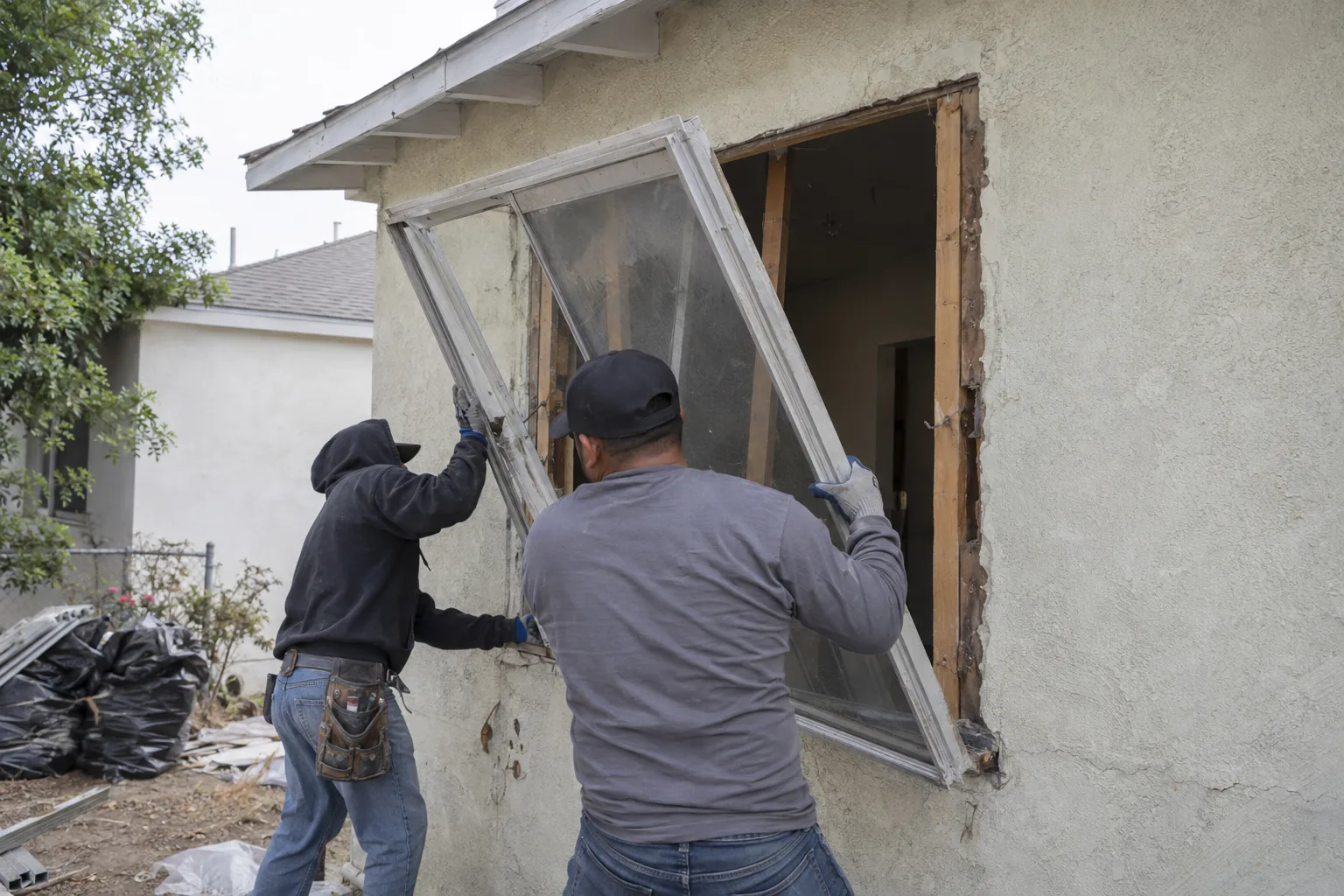
One crew handles the opening, the frame, and the finished wall.
What Window and Door Installation Actually Covers in an Older LA Home
In a house built before 1980, pulling a single-pane window - a glass unit with no insulating gap, standard in older LA housing - often exposes a rough opening that has shifted. The rough opening is the framed cavity in the wall that holds the window or door unit. When foundations move, rough openings move with them. They go out of square. The new unit won't seat flat if the opening isn't corrected first.
Remodeling & More LA installs windows and doors as a full-scope service. That means framing repair, new insulation packed into the wall cavity, drywall patched to the interior finish line, and trim painted before we leave. One crew. One scope. No part of the wall left half-done.
That's what window and door installation in Los Angeles actually covers when it's done right.
Why El Monte, Alhambra, and San Fernando Have More Single-Pane Windows Than Most of LA
These neighborhoods hold some of the oldest unmodified housing stock in the greater Los Angeles area.
Homes in El Monte, Alhambra, and San Fernando were built heavily during the postwar boom - the 1950s through the late 1960s. Many were built fast, with materials that matched the code of the time. Single-pane glass was standard then. No insulation between the panes. No thermal break in the aluminum frame.
Here's what most homeowners don't realize about postwar LA construction: the frames weren't designed to flex. But the soil in the eastern San Gabriel Valley and the San Fernando floor moves with moisture and seismic activity. Frames rack. Gaps open at the jamb - the structural surround that holds the door or window in place. Weatherstripping, the sealing material around door edges, compresses and splits after years of sun exposure.
We dispatch from Studio City directly into these areas. We see the same patterns on house after house. The work we do addresses what's actually there - not just what's visible from the street.
A Call We Often Get: One Window Replaced, Three Problems Found Behind the Frame
Pulling a single unit often reveals what decades of deferred maintenance have hidden.
A call we often get goes something like this. A homeowner in Van Nuys wants one bedroom window replaced. The old unit is fogged - condensation locked between layers of failing glass - and the frame leaks air on cold nights. They want a straight swap.
We pull the unit. The rough opening is out of square on the bottom sill plate. The insulation in the cavity is the original fiberglass from the 1960s - flattened to almost nothing, doing very little. The drywall around the interior edge has stress cracking where the frame shifted.
At that point, the job has three layers: reframe the opening so the new dual-pane unit - insulated glazing with two panes separated by an air gap - sits flat and seals properly; pack the cavity with new insulation; patch and paint the interior wall back to a clean finish.
Because our crew handles all three in-house, the sequence runs without a pause. Framing crew squares the opening. Unit goes in. Insulation fills the cavity. Drywall goes back. Trim gets set and painted. The homeowner gets a finished room, not a patched wall with tape lines showing.
That's the difference between a window installation and a window replacement done to a full interior standard. In older Los Angeles homes, the distinction matters almost every time.
Here Is How We Protect the Wall While the Work Is Done
Every opening gets assessed before the old unit comes out. That's the step that keeps the job sequence on track.
Before we remove anything, we check the rough opening dimensions, look at the surrounding drywall condition, and identify whether the framing shows signs of racking or water intrusion. That walkthrough takes minutes and shapes the entire job sequence.
Interior finish work - the drywall patching, trim installation, and painting that restores the wall after installation - is planned from the start, not figured out at the end. We don't tape off the room and leave paint to dry on your schedule. Finish work is part of the project scope. It's staffed and sequenced before the first unit comes out.
Your wall goes back together clean. That's the standard we hold on every window and door installation we take on in Los Angeles.
From Rough Opening to Painted Trim - Our Installation Sequence
Our quality standard is a finished wall, not just a seated unit. Every project follows the same build-order logic.
- Rough opening check:Verify dimensions, square, and plumb before ordering or setting any unit
- Framing repair:Correct any racking, rot, or out-of-square condition in the structural opening
- Unit installation:Set the new window or door to the corrected opening with proper shimming and fastening
- Insulation:Pack the cavity with high-density insulation before closing the wall
- Weatherstripping and sealing:Seal all exterior edges; verify weatherstripping on door units seats fully
- Drywall patching:Close the interior wall to a smooth finish-ready surface
- Trim and paint:Install interior casing, prime, and paint to match the surrounding finish
No step is skipped. No step is handed off to a separate trade.
How We Measure, Set, Seal, and Finish Every Unit
The sequence is what controls the outcome. Skip a step and the next one compounds the error.
Measuring the Opening
We measure the rough opening at three points - top, middle, and bottom - because postwar Los Angeles walls rarely measure the same at every level. We check for plumb on the jamb sides and level on the sill. We flag any framing issues before the old unit comes out. If the opening needs reframing, that work is scoped and communicated before demolition begins.
Setting and Sealing the Unit
The old unit is removed with the surrounding wall surface protected. The rough opening is corrected to accept the new unit square and level. The new window or door is set, shimmed, and fastened to manufacturer spec. The cavity receives insulation before the wall is closed. Exterior edges are sealed. On door units, weatherstripping is checked for full contact around the entire perimeter.
Finishing and Verifying the Work
Before finish work begins, every installed unit is tested. Windows are opened and closed through their full range. Locks and hardware are seated and functional. Door units are checked for smooth swing and full latch engagement. We verify the weatherstripping seal by feel and visual inspection at the perimeter. Interior drywall is patched and painted, and trim is set before the crew leaves the site.
Neighborhoods and Zip Codes We Reach From Studio City
Remodeling & More LA covers a wide stretch of greater Los Angeles from our Studio City dispatch location.
We regularly serve El Monte, Alhambra, San Fernando, Van Nuys, Glendale, Burbank, Pasadena, West Hollywood, Beverly Hills, Culver City, Santa Monica, Long Beach, Inglewood, Torrance, and communities across the San Fernando Valley. If your neighborhood isn't listed, call us. Our reach across Los Angeles is broad.
Ready to Schedule a Walk-Through? Here Is What Happens Next
The first step is a site visit - not an estimate over the phone.
Window and door installation in Los Angeles involves too many variables for a phone quote to mean much. We walk the openings, check the framing condition, and give you a clear picture of the full scope. Call us at +17693799653 or email info@remodelingmore.com to set up your walk-through. We'll tell you exactly what the job involves before any work begins.