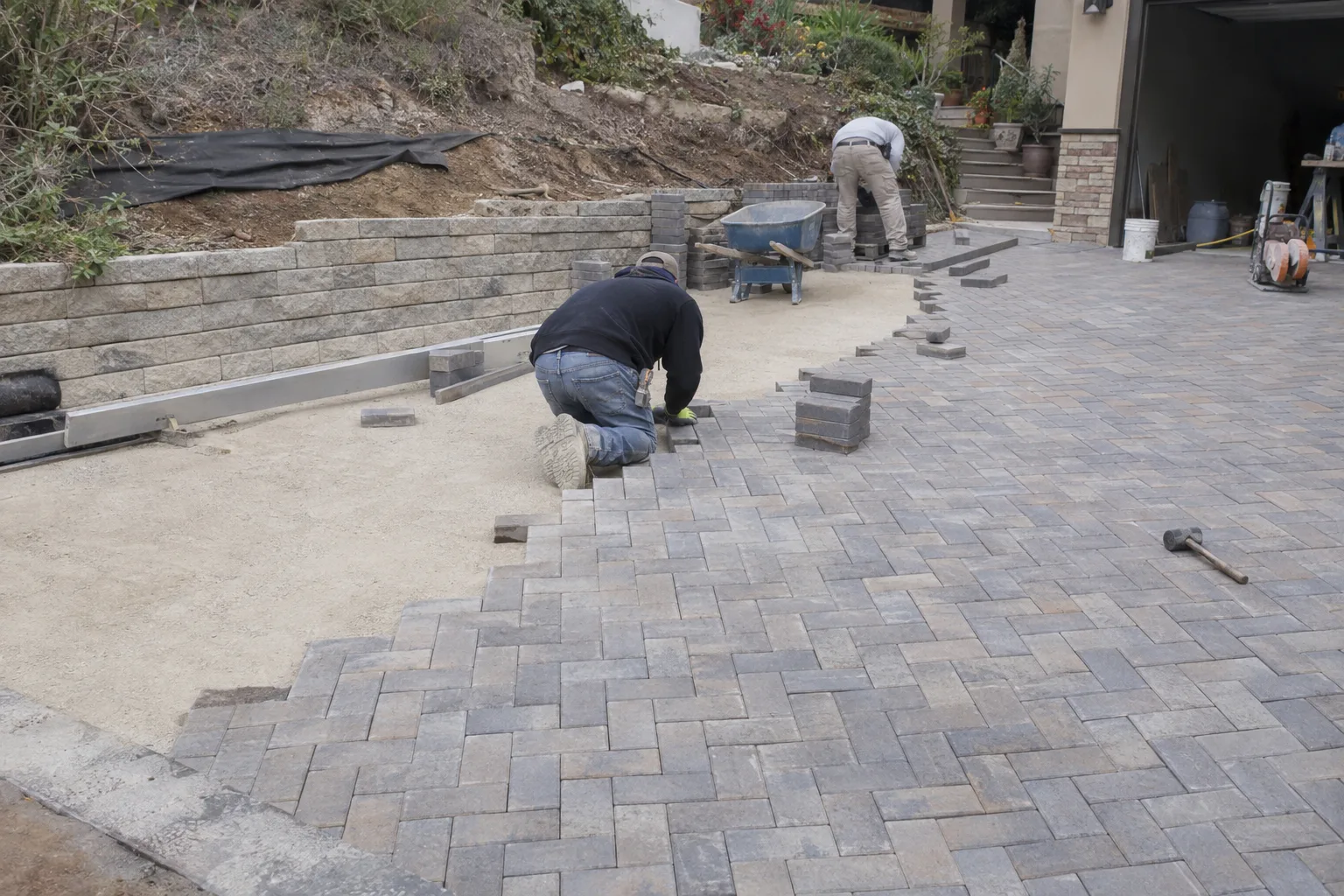
One crew handles your pavers, borders, and retaining walls - no coordination gaps.
What Concrete Pavers Actually Deliver Outdoors in Los Angeles
Concrete pavers give you a hard, durable outdoor surface that also looks intentional.
Los Angeles puts outdoor surfaces through a specific kind of stress. Summer heat bakes surfaces for months. Ground movement is common in hillside and clay-soil areas. Pavers handle both better than a continuous slab, because the joints absorb minor movement rather than transmitting it as a crack across the whole field.
The result is a surface that holds up to vehicle weight, foot traffic, and Southern California's seasonal extremes - while giving you real design options from the start.
Why Surface Material Matters in Pasadena, Malibu, and LA's Hillside Communities
In Los Angeles, the surface material isn't just about looks - it's part of how a property reads from the street.
Here's what most homeowners don't realize about hillside properties: drainage is as important as the surface itself. In communities like Malibu, Pasadena, and the hillside neighborhoods above the Valley floor, grade changes mean water has to go somewhere. A well-planned paver field uses residential drainage planning - how slope and joint spacing direct water off a surface and away from structures - to keep water moving in the right direction.
Properties in Pasadena, for example, often sit on older lots with mature landscaping and established hardscape. Adding pavers means working around existing borders, walls, and grade transitions. That requires planning the surface as part of the whole picture, not as a standalone pour.
Remodeling & More LA operates out of Studio City and works regularly across these neighborhoods. The crew understands what higher-end residential areas expect in terms of finish quality and site integration.
A Project Combination We Handle Often: Driveway, Walkway, and Wall in One Scope
The most common paver calls we get in Los Angeles aren't for a single surface - they're for a connected set of them.
A driveway leading to a front walkway, with a grade change at the property edge that needs a retaining wall. That's a typical combination. Each piece connects to the others, and the way they connect determines how the finished property looks and performs.
When the driveway paver field meets the walkway, the pattern layout - herringbone, running bond, and basket-weave configurations that affect both look and structural performance - needs to transition cleanly. The edge treatment at the retaining wall interface - the relationship between a paver field and any adjacent grade-change structure - has to be planned before the first unit goes down, not figured out at the end.
That's where a single-scope crew makes a practical difference. The paver base preparation, the wall footing, the drainage slope - all of it is coordinated in one plan. Nothing gets contradicted by a separate contractor who didn't know what the first one built.
We see this scenario often in neighborhoods like Culver City and West Hollywood, where front-of-property presentation matters and lots are tight enough that every detail between a driveway edge and a planting border is visible from the street.
The planning is what makes it work. Pavers look straightforward. Getting them to stay straight, drain right, and integrate with walls and borders over time is where the work actually lives.
How a Proper Paver Base Keeps the Surface Stable Long-Term
A paver surface is only as good as what's underneath it.
Paver base preparation - the compacted gravel and sand layers that support long-term stability - is not a shortcut zone. In Los Angeles, where expansive clay soils are common in many neighborhoods, the base depth and compaction level directly affect whether the surface stays flat in five years.
The general standard is a compacted aggregate base layer followed by a bedding sand layer. Depth depends on the application. A driveway handling vehicle weight needs more base material than a garden walkway. Getting that wrong means pavers sink, tip, or shift - and the fix is pulling the surface up and starting over on the base.
Joint sand - the fill material between pavers that locks the surface and manages weed intrusion - matters too. Polymeric sand, a jointing material that hardens when activated with water, significantly reduces weed growth and joint erosion compared to standard sand. It's worth the additional step.
We plan base depth and joint material based on what the surface is doing - not a one-size spec.
How We Plan and Install Concrete Paver Surfaces
Every paver project starts with how the surface connects to everything around it.
What we focus on before a single unit goes down:
- Surface use and load:Driveway, patio, and walkway each have different base requirements
- Drainage slope:Every paver field needs a planned pitch for water to move correctly
- Pattern selection:Herringbone provides the best interlocking strength for driveways; running bond and basket-weave work well for patios and walkways
- Edge and border treatment:Edge restraints hold the field together; borders define transitions to adjacent surfaces
- Hardscape integration:If the project includes walls, stonework, or adjacent concrete, all transitions are planned as one design - not added on at the end
- Joint fill specification:Polymeric sand is standard for most Los Angeles outdoor applications given the heat and occasional weed pressure
One crew manages the full scope. No subcontract handoffs between paver work and adjacent masonry.
Base Preparation, Pattern Layout, and Joint Finishing - Each Step Explained
Good paver installation follows a fixed sequence - and skipping any step shows up later.
Diagnostics: Site Assessment and Planning
The surface gets assessed for existing grade, drainage direction, and soil type. In hillside Los Angeles neighborhoods, that assessment also includes how the paver field connects to any walls, curbs, or planted borders. Pattern layout is selected based on surface use, not just appearance.
Implementation: Excavation, Base, and Setting
Excavation removes existing material to the required depth. Compacted aggregate base goes in first - typically a minimum of 4 inches for pedestrian surfaces, deeper for driveways. Bedding sand follows, screeded level. Pavers are set in the chosen pattern layout, cut to fit at edges. Edge restraints are installed to hold the field shape. If the project includes retaining wall interface sections, those tie into the base plan directly.
Post-Service Testing: Inspection and Joint Activation
Once the field is set, it gets walked and inspected for level, consistent joint width, and pattern alignment. Polymeric sand is swept into joints and activated with water. The surface is left ready for immediate foot traffic. Driveways are typically ready for vehicle use within 24 hours of joint activation, depending on conditions.
Where We Install Concrete Pavers Across Greater Los Angeles
Remodeling & More LA installs concrete paver surfaces throughout Greater Los Angeles.
We serve Los Angeles, West Hollywood, Beverly Hills, Culver City, Inglewood, Burbank, Glendale, Santa Monica, Pasadena, Malibu, Manhattan Beach, Redondo Beach, Hermosa Beach, Torrance, Long Beach, Woodland Hills, Calabasas, Chatsworth, Van Nuys, and surrounding communities across the region.
Ready to Choose Your Surface? Here's How to Start
Tell us what you're working with and we'll scope the full project.
Reach out by phone at +1 (769) 379-9653 or email info@remodelingmore.com. Describe the surface - driveway, patio, walkway, or a combination - and note any adjacent walls or grade changes. We'll plan it as one integrated project from the start.