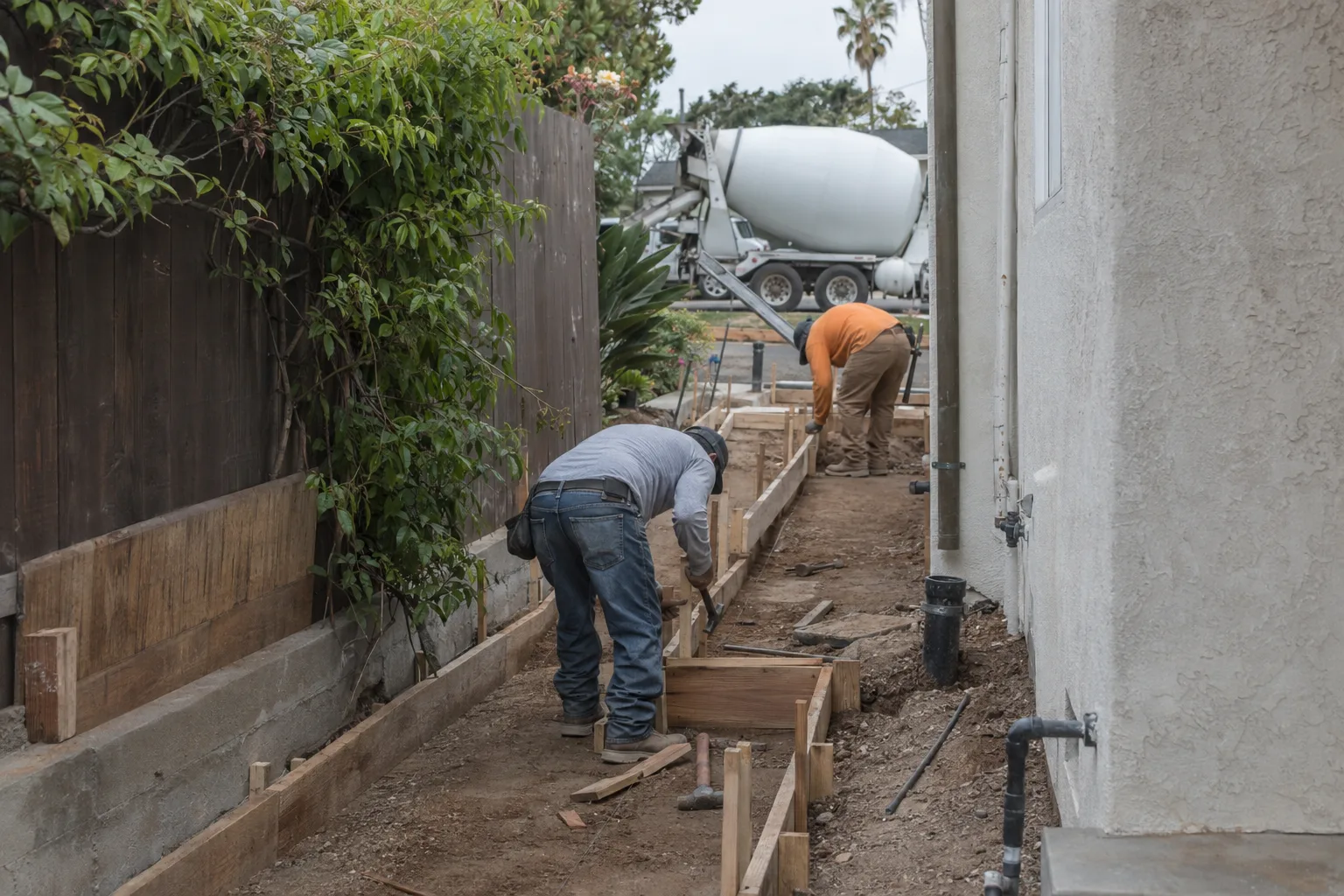
One crew handles grading, prep, and the full pour - start to finish.
What a Concrete Walkway Installation Includes
A concrete walkway is a formed, poured, and finished slab - purpose-built to connect spaces on your property.
It starts at the ground - literally. Before any concrete is mixed, the ground underneath has to be right. That means leveling, compacting, and in many Los Angeles yards, correcting drainage so water moves away from the slab once it's poured.
The prep work takes longer than the pour. That's true of most concrete walkway jobs, and it's worth knowing before you schedule.
A typical installation covers front entries, side yard paths, and inter-space routes - like the gap between your driveway and a detached garage. Remodeling & More LA handles all of it. Concrete installation, site preparation, and excavation all fall under one team, so you are not piecing together multiple contractors.
Why Los Angeles Properties Benefit From Poured Concrete Paths
Los Angeles lot conditions make a well-prepped concrete path a smart long-term choice.
This region has a wide mix of soil types. In the San Gabriel Valley - think Arcadia, Monrovia, Alhambra - older residential lots frequently sit on expansive clay soils. Those soils swell when wet and shrink when dry. A shallow or uncompacted subbase - the compacted gravel or sand layer beneath the slab that resists settling - can shift noticeably within a single rainy season.
The Los Angeles basin also has mature street trees on nearly every block. Ficus, liquid amber, and old sycamores push root systems that can travel 20 to 30 feet from the trunk. Any path laid without proper depth and compaction is vulnerable to that movement over time.
Then there is the slope factor. Very few residential lots in this city are truly flat. From Carson up through Downey and into the Van Nuys flatlands, even modest grade differences affect how water drains off a finished walkway. Getting site grading - leveling and sloping the ground for proper drainage before pouring - right on the front end is what separates a path that holds up from one that puddles and cracks.
A Situation We See Across LA Neighborhoods
This is a project type that comes up constantly in established Los Angeles neighborhoods.
A call we often get goes something like this: the homeowner has a side yard with a dirt path that turns into a muddy mess after any significant rain. Sometimes there are old stepping stones laid decades ago - settled at odd angles, separated by gaps where weeds push through. The homeowner wants something finished, clean, and permanent.
When we look at the site, the ground usually tells a more complete story. There may be a subtle slope directing water toward the house rather than away from it. There may be tree roots just below the surface that need to be addressed before anything goes down. In some cases, the neighbor's existing concrete work has influenced drainage patterns in ways the homeowner never noticed.
That is exactly why we start with the ground. Formwork - the temporary framing that shapes the concrete pour - only works well when the base is correctly graded and compacted first.
For side yard paths, the width matters too. Standard residential walkways run 36 to 48 inches. But a side yard that doubles as equipment access or gate clearance may need 48 to 60 inches to be functional. We size the pour to the actual use, not a default dimension.
Once the subbase is compacted and the formwork is set, we plan control joints - planned cuts in the slab that manage cracking as concrete cures and shifts with temperature. In a climate that swings from wet winters to dry, hot summers, concrete moves. Planned joints direct that movement where you want it, keeping the slab intact and even.
How We Set Up Every Pour for Long-Term Performance
Every walkway we install is graded, compacted, and formed before a single yard of concrete is mixed.
Control joints are planned into every pour - not added as an afterthought. The slab is sized and positioned to accommodate movement without cracking through the middle of the path.
Aggregate finish - the surface texture applied to concrete that affects both grip and appearance - is confirmed before the pour starts. A broom finish gives reliable traction for a front entry. Exposed aggregate works well where the walkway meets an existing decorative surface. We confirm which direction works for your property before the work begins.
If your walkway project is part of a larger outdoor scope - a driveway, a patio, retaining wall work - the same crew manages all of it. One team. One schedule.
From Grading to Final Finish: How the Work Gets Done
Every phase of a concrete walkway installation follows a clear, sequential process.
Site Review
We look at the full path before quoting or scheduling. That includes ground slope, existing surfaces, root proximity, and how water currently moves across the site. If drainage correction or excavation is needed, we identify it here - not mid-job.
Installation
- Excavate to proper depth and remove existing material
- Compact subbase layer to resist settling
- Set formwork to define width, alignment, and edge
- Install expansion joints - material placed between the walkway and adjacent structures to allow movement without cracking - where the slab meets the house, fence, or driveway
- Pour and finish to selected aggregate texture
- Cut control joints to planned spacing once concrete reaches the appropriate cure stage
Post-Installation
We confirm the finished surface drains correctly before we leave the site. Any surface sealing, if applicable to the selected finish, is addressed at this stage. Formwork is removed and the surrounding area is cleaned up.
Walkway Projects Across the Los Angeles Basin
Remodeling & More LA serves concrete walkway projects from the South Bay to the San Gabriel Valley.
We work across zip codes including 90220 (Compton), 90745 (Carson), 91007 (Arcadia), and 91016 (Monrovia). Project areas also include Torrance, Hawthorne, Downey, El Monte, Van Nuys, and throughout the San Fernando Valley. If your property is in the greater Los Angeles area, reach out and we'll confirm coverage.
Ready to Put in a Concrete Walkway? Here's How to Start
Contact Remodeling & More LA and we'll look at your site, understand what's underneath, and build you a path that holds.
Call +17693799653 or email info@remodelingmore.com. Describe your project - where the path goes, approximate length, and any slope or drainage details you already know. We'll take it from there.