One in-house crew handles your full concrete scope - from grade prep to finished surface.
What Concrete Installation Covers on a Los Angeles Property
Concrete installation in Los Angeles covers driveways, walkways, patios, slabs, and structural bases.
Remodeling & More LA handles all of it under one scope. The mix, the slope, and the surface finish stay consistent from one poured area to the next. One crew. One standard. No handoff between trades.
We serve residential and multi-family properties across the Greater Los Angeles area - from Long Beach north through the San Fernando Valley, and from Santa Monica east to Pasadena.
How LA's Soil and Terrain Shape Every Concrete Pour
Los Angeles terrain makes sub-base preparation the most important part of any concrete job.
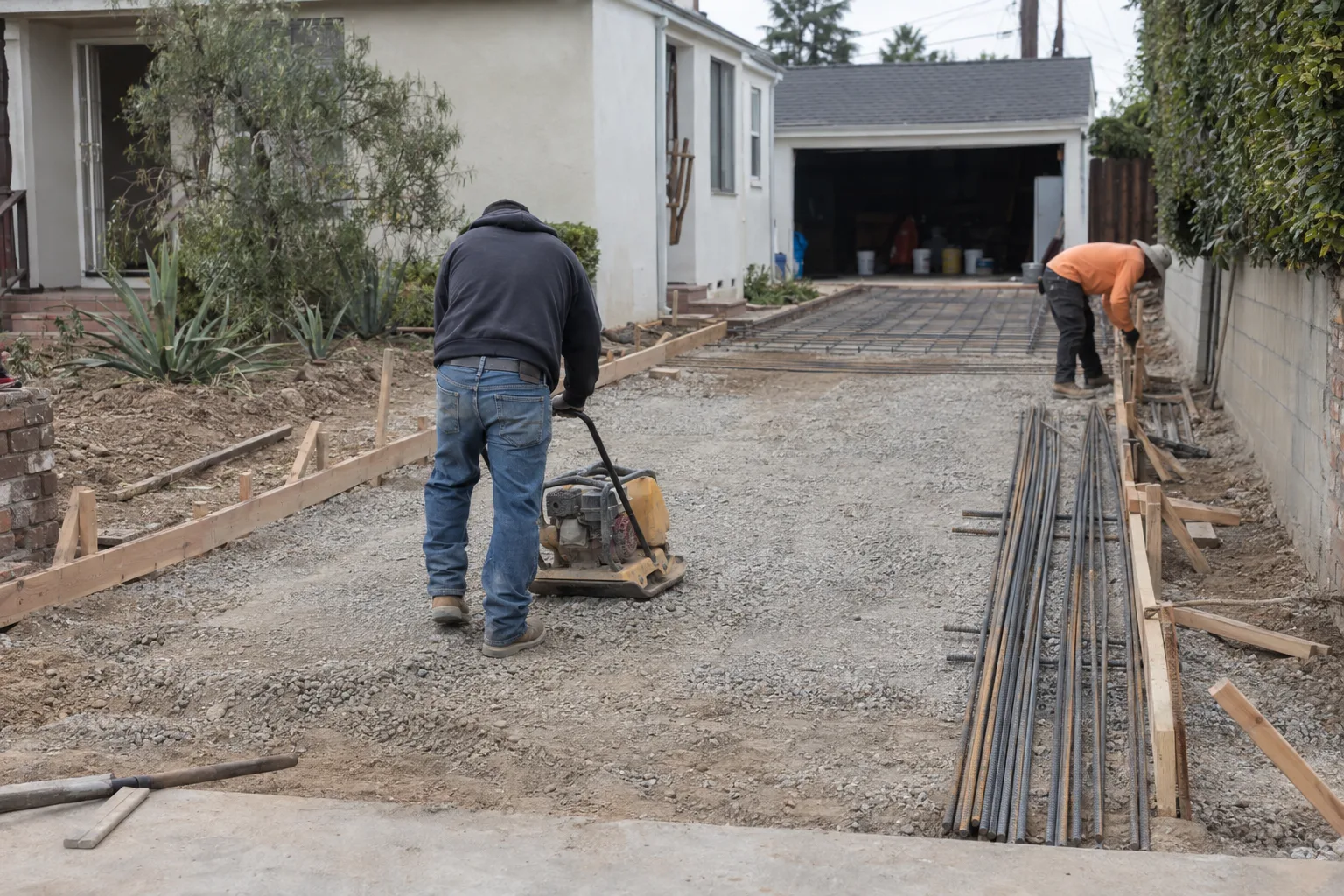
The pour itself is roughly 30% of the work. Grade preparation - leveling and compacting the soil or gravel sub-base before a single truck arrives - determines whether that slab stays flat in five years or starts shifting.
Southern California sits on a mix of clay-dense soil in the flatlands and sandy decomposed granite on hillside lots. Clay expands when it gets wet and contracts in dry spells. That movement telegraphs directly into a slab poured on top of it. In neighborhoods like the San Fernando Valley or the Pasadena foothills, slope and drainage direction also affect where water pools under a slab during winter rains. A sub-base that isn't graded and compacted correctly before the pour will settle unevenly - regardless of how well the concrete itself is mixed.
We account for all of this before we pour, every time.
A Call We Often Get: "The Slab Is Fine - It Just Needs to Be Level"
The most common concrete request we hear is also the one that requires the most upfront honesty.
A call we often get goes something like this: a homeowner in Burbank or Culver City has an existing driveway slab. It's cracked in one section, heaved in another, and scrapes low-clearance cars at the apron. They want it leveled. Sometimes leveling is the right answer. More often, the slab has moved because the sub-base beneath it has shifted - and adding material on top of a compromised base delays the next failure.
When we look at a slab like that, we check crack continuity, whether the heave is isolated or part of a pattern, and what the drainage situation looks like at the edges. A hairline crack at an expansion joint - a planned gap in a concrete surface that allows movement and reduces cracking - is expected and manageable. A crack that runs diagonally across a 20-foot span tells a different story about what's underneath.
Sometimes a partial demo and repour is faster and less expensive than patching over structural movement. We say so clearly, before any work starts.
We carry the same approach to new pours. When a backyard ADU is being built and the foundation slab is going in, we look at how that concrete ties into the existing walkway grade. If the elevations don't match, water runs toward the structure. Getting those grades right on the first pour is always better than correcting them later.
Your Concrete Scope Stays in One Set of Hands
When your driveway, walkway, and patio are poured by the same crew, the finish lines up.
Multi-surface concrete projects are common in LA - especially when a homeowner is adding an ADU, extending a driveway for a second unit, or regrading the backyard. Splitting that work between separate crews creates continuity problems. Surface finishes don't match. Slopes don't flow correctly from one poured area to the next. Expansion joints end up misaligned or placed by habit rather than calculated position.
Remodeling & More LA keeps all concrete work in-house. The same crew that pours your driveway handles the connecting walkway and the patio beyond it. The broom finish or exposed aggregate pattern carries through the full surface, and the drainage grade runs consistently in the right direction. If your project also includes a retaining wall or ADU foundation, those elements get coordinated from the same scope - no separate party to align with.
From Grade Preparation to Final Surface Finish - How We Work
Every concrete job follows the same quality steps, regardless of surface type or size.
What we hold to on every pour:
- Sub-base compactionto the correct depth before formwork goes in
- Rebar reinforcementsteel rod embedded in poured concrete to prevent cracking under load - sized to the surface type and expected load
- Concrete formworktemporary framing that holds wet concrete in shape while it cures - set to the correct grade and slope before the pour begins
- Mix specificationmatched to the application: driveway, patio, or structural base
- Curing timethe period required for poured concrete to reach full structural strength - observed fully before any surface load is applied
- Expansion joint placementcalculated, not approximate
- Surface finishconfirmed before pour day, applied consistently
No shortcuts on sub-base prep. Curing time is not compressed to meet a schedule.
Surface Types, Mix Standards, and Finish Options We Apply
The right concrete finish depends on the surface use, the slope, and the surrounding architecture.
Before the Pour
Before any concrete work begins, we walk the full project area. We check existing grades and drainage direction. We identify tree roots, buried irrigation lines, or existing concrete edges that need to tie in. On sloped lots - common in areas like Malibu and the hillside neighborhoods above Burbank - we determine the drainage runoff path and set form grades accordingly.
Surfaces We Pour
Driveways get a 4-inch minimum slab depth with rebar reinforcement, broom-finished for traction. Expansion joints are placed every 10 to 12 feet or at control points.
Walkways and patios are finished to the project spec - broom, trowel-smooth, or exposed aggregate, where decorative stone is revealed at the surface. Slopes are set to move water away from the structure.
Structural and foundation pours - for ADU slabs, retaining wall bases, and garage floors - follow depth and rebar schedules matched to the structural load. These pours tie into any adjacent hardscape work under the same scope.
Concrete pavers and decorative finishes are coordinated with our hardscape design and installation work when the project calls for both.
After the Pour
Curing time is respected. Concrete finishing - the surface treatment applied after the pour - is inspected before we close the scope. If the finish doesn't meet what we committed to at the start, we address it before the project is signed off.
Concrete Installation Across Greater Los Angeles
We pour concrete across the full Greater Los Angeles basin - from the coast to the foothills.
Remodeling & More LA serves [Los Angeles](/), Burbank, Long Beach, Pasadena, Anaheim, and the San Fernando Valley. We also work across West Hollywood, Beverly Hills, Santa Monica, Culver City, Glendale, Torrance, Manhattan Beach, Woodland Hills, Calabasas, and beyond. If you're in Greater LA and need concrete work done to a consistent standard, we're in your area.
Ready to Move Forward on Your Concrete Project?
Contact Remodeling & More LA and let's talk through your concrete scope.
Call us at +1 (769) 379-9653 or email info@remodelingmore.com. Tell us what surface you need poured, where the property is, and what you're trying to accomplish. We'll get you clear answers before any work begins.