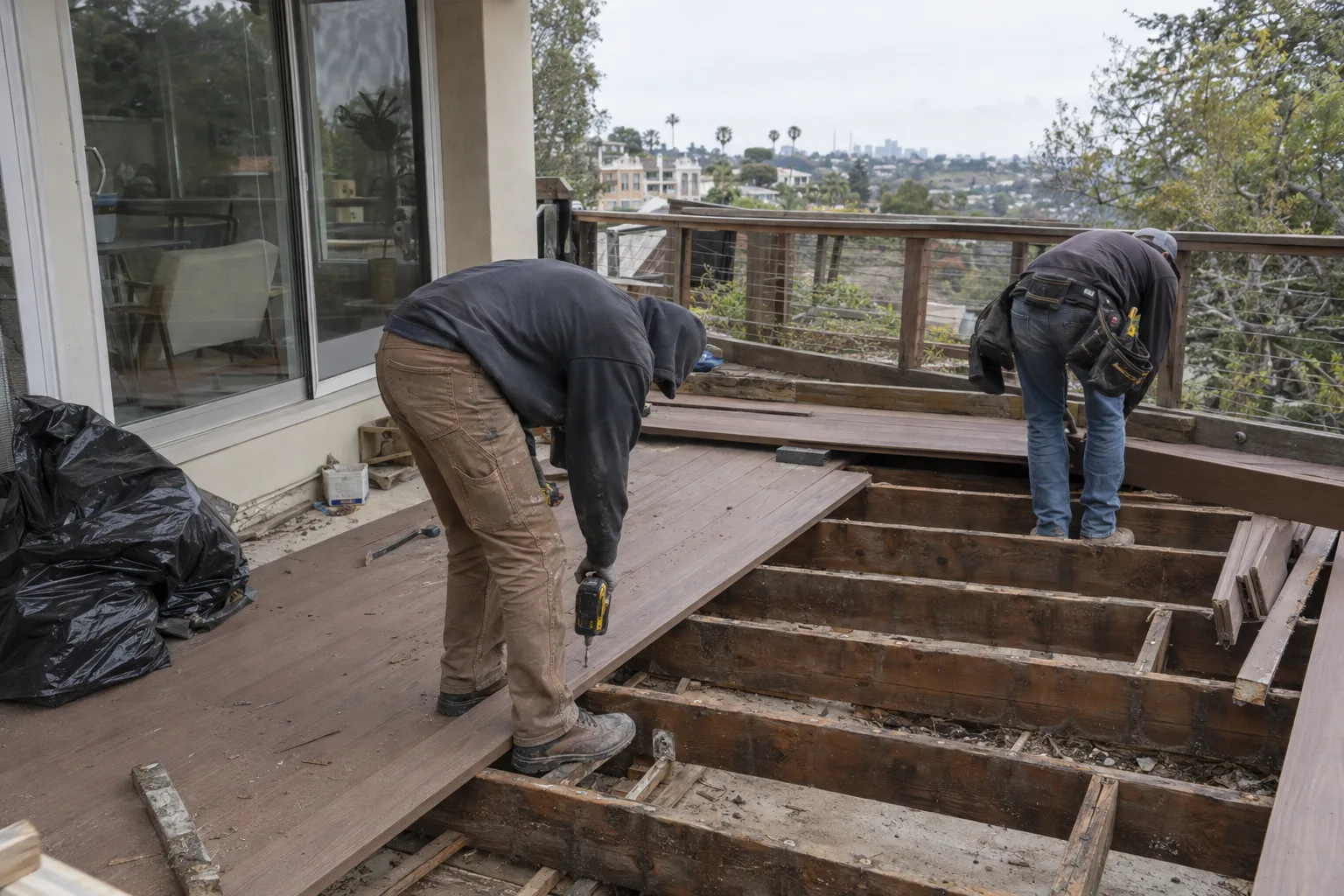
One crew handles boards, framing, and finish - start to done.
What Deck Repair Actually Covers
Deck repair is more than swapping a board or two - it's a full assessment of surface, structure, and connections.
The goal isn't just fixing what's broken today. It's understanding why it broke and what else needs attention before it does. A properly repaired deck in Los Angeles should handle years of sun, the occasional wet season, and daily foot traffic without needing emergency attention in between.
How LA's Climate Works on Deck Materials Over Time
Los Angeles puts decks through a slow, specific kind of stress - and most of it happens before you see visible damage.
Here's what most homeowners don't realize about deck wear in Los Angeles: the damage accumulates in cycles, not events. For most of the year, strong UV exposure dries out wood fibers. Surfaces fade. The top layer of wood starts to gray and contract slightly. That contraction opens micro-cracks along the grain.
Then the wet months arrive - typically November through March. Water moves into those cracks. The wood swells. Fasteners that held tight in summer start to back out as the board shifts around them. Then the wood dries again. It shrinks. The fastener hole is now slightly larger than it was. The board becomes less stable with each cycle.
Hillside lots in Studio City, Silver Lake, and the Hollywood Hills face an added factor. Elevated decks on west-facing slopes absorb direct afternoon sun from mid-afternoon until sunset, every day. That's two to three additional hours of UV load compared to a flat-lot deck of the same age. Wood surface sealing - a protective coating applied after repair to slow further UV and moisture damage - degrades faster on these exposures and needs attention sooner.
A Call We Get Often - and What It Usually Means
A soft spot underfoot is the most common reason homeowners call us - and it almost never stays a surface-only fix.
A call we get often goes something like this: a homeowner noticed one board felt springy when they stepped on it. They figured it was just that one board. They wanted to know if it could be replaced quickly.
What that soft feeling usually means is that moisture has worked its way into the framing - specifically the joist or blocking directly beneath that board. Deck boards themselves don't go soft on their own. They crack, split, or warp. Softness underfoot points to dry rot - wood decay caused by fungal activity in persistently damp framing members - in the structure below.
When we open up a section like that, we check the full span of the affected joist, not just the area under the one board that felt off. Dry rot travels. A joist that's compromised at one point is often weakened further along, especially if water had a consistent path in - a gap in the decking above, a failed fastener creating a pocket, or a ledger board connection that wasn't properly flashed against the house.
This is exactly why scope matters before any work begins. Replacing a surface board without checking the framing underneath is a short-term answer to a longer problem. Our crew evaluates both - surface and structure - before we touch anything. That way, what gets repaired stays repaired.
You'll Know the Full Scope Before Any Work Starts
Every deck repair we take on begins with an honest assessment of what's actually there.
A question we hear often: "Will this turn into a bigger project than I expect?" That's a fair question. The answer is: it depends on what's underneath, and we'll tell you what we find before any work starts.
Our process doesn't involve pulling up boards and then presenting you with a surprise scope. We evaluate the surface, probe the framing, check the ledger board - the board that ties the deck to the house structure - and assess fastener corrosion, meaning screws and nails that have backed out or rusted from repeated wet-dry cycles. Then we give you a clear picture of what needs to happen.
Some jobs are straightforward - a handful of deck boards replaced, fasteners reset, surface sealed. Others reveal framing issues that need to be addressed to make the surface work safe and lasting. Either way, you'll know before we start, not after.
How We Assess, Plan, and Carry Out Deck Repairs
Deck repair at Remodeling & More LA follows a set order - inspection first, scope second, work third.
Our assessment covers every layer of the deck system. Here's what that looks like in practice:
- Surface evaluation:Every deck board checked for cracking, cupping, warping, and softness. UV degradation and moisture cycling both leave distinct patterns - we read both.
- Fastener check:Screws and structural nails inspected for corrosion and pullout. Backed-out fasteners are a sign of board movement, not just age.
- Framing and joist inspection:We probe for dry rot and soft spots in the structural skeleton beneath the surface. A compromised joist changes the repair scope significantly.
- Ledger board connection:The point where the deck meets the house is a critical inspection point in older Los Angeles construction. We check flashing, fasteners, and wood condition here every time.
- Wood surface sealing review:If a protective coating was applied previously, we assess its condition and whether it needs to be stripped, sanded, or replaced entirely before recoating.
Our in-house crew covers framing, finish carpentry, and surface painting. Deck restoration often crosses all three trades. One crew, coordinated internally - no gaps between contractors.
From Surface Work to Structural Fixes - How the Crew Moves Through the Job
The repair sequence runs from structure up to surface - that order isn't optional.
Diagnostics
Every job begins with a deck inspection - a systematic evaluation of surface, structure, and connections. We start at the ledger board and work outward. Surface boards are walked and pressed. Joists are probed. Fastener patterns are reviewed. Any area that shows softness, visible rot, or unusual movement gets flagged before we commit to a scope.
If the inspection reveals structural issues, those get addressed first. Repairing deck boards over compromised framing produces a deck that looks better but isn't safe or durable.
Implementation
Board replacement comes first when surface work is the primary scope. We match lumber species and profile as closely as possible for consistency across the deck surface. Fasteners are replaced with corrosion-resistant hardware appropriate for outdoor exposure in Los Angeles's climate.
Framing repairs - replacing or sistering damaged joists, rebuilding a rotted ledger board section - happen before any surface boards go back down. We don't close up structural work until the crew lead on site has reviewed it.
Post-Service Testing
After repairs are complete, the deck surface gets a full walk. We check for movement, flex, or noise that shouldn't be there. If the scope included surface sealing or a protective coat, we confirm coverage and adhesion before we close out the job.
The finish matters as much as the framing. A properly sealed deck surface in Los Angeles - especially on a west-facing or hillside elevation - slows the UV and moisture cycling that caused the original damage. That's the goal: a repair that resets the clock, not just patches the surface.
Deck Repair Service Across Los Angeles and Surrounding Communities
Remodeling & More LA serves homeowners throughout greater Los Angeles and the surrounding region.
We work across Los Angeles, West Hollywood, Beverly Hills, Culver City, Santa Monica, Burbank, Glendale, Pasadena, and Long Beach. Our crews also serve the San Fernando Valley - including Van Nuys, Woodland Hills, Chatsworth, and Calabasas - plus South Bay communities like Torrance, Redondo Beach, Manhattan Beach, and Hermosa Beach.
Ready to Have Your Deck Looked At?
If something feels off underfoot - or if your deck hasn't been assessed in a few seasons - now is the right time.
Start with a conversation. Call Remodeling & More LA at +1 (769) 379-9653 or email info@remodelingmore.com. Describe what you're seeing, and we'll talk through next steps. We work across Los Angeles and the surrounding communities. The sooner we look at it, the more options we have.