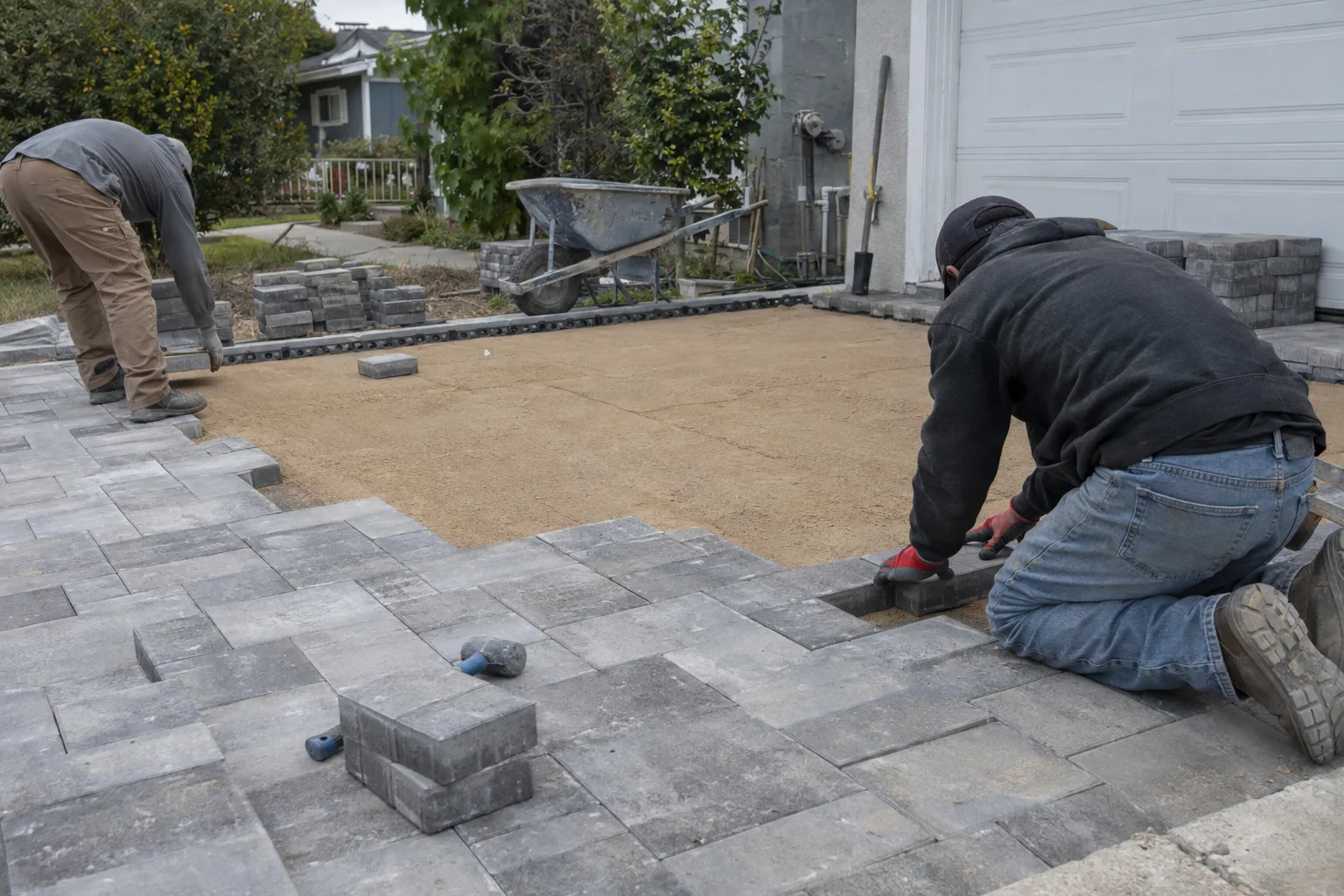
One crew handles excavation, grading, and paver placement - start to finish.
What Goes Into a Paver Installation That Holds
A paver surface is only as stable as what sits beneath it.
Three things control long-term performance. Excavation depth - how far down soil is removed to accommodate base material and pavers to finished grade - sets the foundation. Compaction of the base layers determines load-bearing stability. And drainage slope, the intentional grade built into every surface to move water away from structures, prevents pooling that degrades the base over time.
Get all three right, and the surface holds. Miss any one of them, and the pavers show it later.
How Southern California Soil Conditions Shape Every Base We Build
Los Angeles soil is not uniform - and base depth decisions are not one-size-fits-all.
The soil type changes significantly by neighborhood across Southern California. Hillside areas like Glendale and parts of Pasadena sit on expansive clay. That clay swells when wet and contracts when dry. Pavers set on clay without adequate base depth and drainage slope will move with the seasonal cycle.
Coastal communities - Huntington Beach, Torrance, Manhattan Beach - often have sandy fill or imported soil from previous grading. Sandy fill compacts differently than native clay. It requires different base thickness and a tighter compaction pass to hold under vehicle weight.
We build base specifications to match site conditions. The base prep we use in a Huntington Beach driveway installation is not identical to what we use on a hillside walkway in Los Feliz. Soil reading is part of the job.
A Call We Often Get: The Driveway That Shifted After the First Winter Rain
A common paver problem in Los Angeles isn't the material - it's what was skipped underneath.
A call we often get involves a driveway that looked level and clean at installation, then developed visible unevenness after the first significant rain of the season. Stones rocking underfoot. Joint gaps opening where they were tight before. Sometimes a low spot where water now collects.
When we walk a site like that, the pavers themselves are usually fine. The stones are intact. The problem is almost always in the base - either excavation that wasn't deep enough, compaction that was rushed, or drainage slope that wasn't established before the pavers went down.
In Los Angeles, the first significant rain after a dry stretch hits fast and hard. Water finds every low point. If a paver base wasn't graded to drain, the water sits. It softens the sand layer beneath the pavers. Once that sand layer shifts, the pavers above it shift with it.
Repairing a failed base is more disruptive than building it correctly from the start. Pavers have to come up. Material has to come out. The ground has to be regraded. Then everything goes back down.
What we establish before the first paver goes down: confirmed excavation depth, compacted gravel base, a bedding sand layer screeded to drainage slope, and edge conditions that prevent lateral movement from the outside in. That sequence is the same whether the project is a 200-square-foot patio or a full driveway replacement.
A paver installation can look identical on day one whether the base work was done thoroughly or not. The difference shows up later. We build the base so it doesn't.
You Can See the Surface - We Account for Everything Underneath
Good paver work is mostly invisible - and that's exactly the point.
When a paver surface is installed correctly, you see flat stones, tight joints, and clean edges. You don't see the gravel base. You don't see the drainage slope built into the grade. You don't see the paver edging - the perimeter restraints that prevent the field of stones from spreading outward over time.
That's how it should look.
Here's what we confirm before any surface work begins: the existing drainage pattern on the site. In Los Angeles, downhill properties and properties near hardscape-heavy lots can have compounding drainage challenges. We account for where water already goes, then set our grading accordingly.
Joint sand - the material between pavers that locks them in position and allows for minor movement - is applied and swept in after the field is set. It's the last step. But the spacing that makes joint sand effective is established when the pavers are placed, not after.
Every part of the system works together. We manage every part.
From Excavation to Final Joint Sand: Our Installation Sequence
Our paver process follows the same disciplined sequence on every project.
What we bring to every paver installation in Los Angeles:
- Excavation to proper depthsoil removed to accommodate full base thickness plus finished paver height
- Subgrade compactionnative soil compacted before any base material is placed
- Gravel base layercrushed aggregate installed and compacted in lifts for load distribution
- Bedding sand layerfine sand screeded to drainage slope; this is the setting bed the pavers rest on
- Paver placementconcrete pavers set to pattern, with consistent joint spacing maintained throughout
- Paver edging / restraintsperimeter anchors installed to prevent lateral movement of the paver field
- Joint sand applicationsand swept into joints, settled, and topped off to lock the field in place
- Final grade checksurface inspected for level, slope, and edge alignment before completion
No steps skipped. No materials substituted to save time.
How We Approach Grading, Compaction, and Edging on Every Job
Three variables determine whether a paver surface performs - grading, compaction, and restraint.
Site Grading and Drainage Slope
Site grading - shaping the ground surface to control drainage and elevation before installation - happens before any base material goes down. We establish the finished surface elevation first, then work backward to set base depth. Drainage slope is built into the bedding sand layer so water moves off the surface from the first rain forward.
Base Compaction
Compaction is done in layers, not all at once. Gravel base material is placed and compacted in increments. This creates uniform density through the full depth of the base. A base placed all at once and compacted only at the top develops soft spots underneath that compress unevenly under load.
Paver Edging and Joint Integrity
Paver edging - the restraints installed at the perimeter of every paver field - holds the installation together at the edges. Without it, the outermost pavers migrate outward over time. Joints widen. The field loosens from the outside in. Edging is installed before joint sand is applied, so the entire field is mechanically secured before the final lock-in step.
Paver Installation Across Los Angeles, Long Beach, Irvine, and the South Bay
We install pavers throughout Greater Los Angeles and across Southern California.
Remodeling & More LA serves homeowners from Studio City and West LA through Long Beach (90802), Torrance (90503), and the South Bay. We work across coastal communities including Santa Monica, Huntington Beach (92648), and Irvine (92618). Inland projects span Pasadena, Burbank, Glendale, and the San Fernando Valley. If your property is within the greater Los Angeles area, we can assess your site and build your base.
Ready to Plan Your Paver Surface? Here's How to Start
Contact Remodeling & More LA and we'll walk through your project from the ground up.
Call us at +1 (769) 379-9653 or email info@remodelingmore.com. Tell us what you're working with - driveway, patio, walkway, pool surround, or a combination. We'll talk through the site conditions and what the installation involves before anything else. Start there.