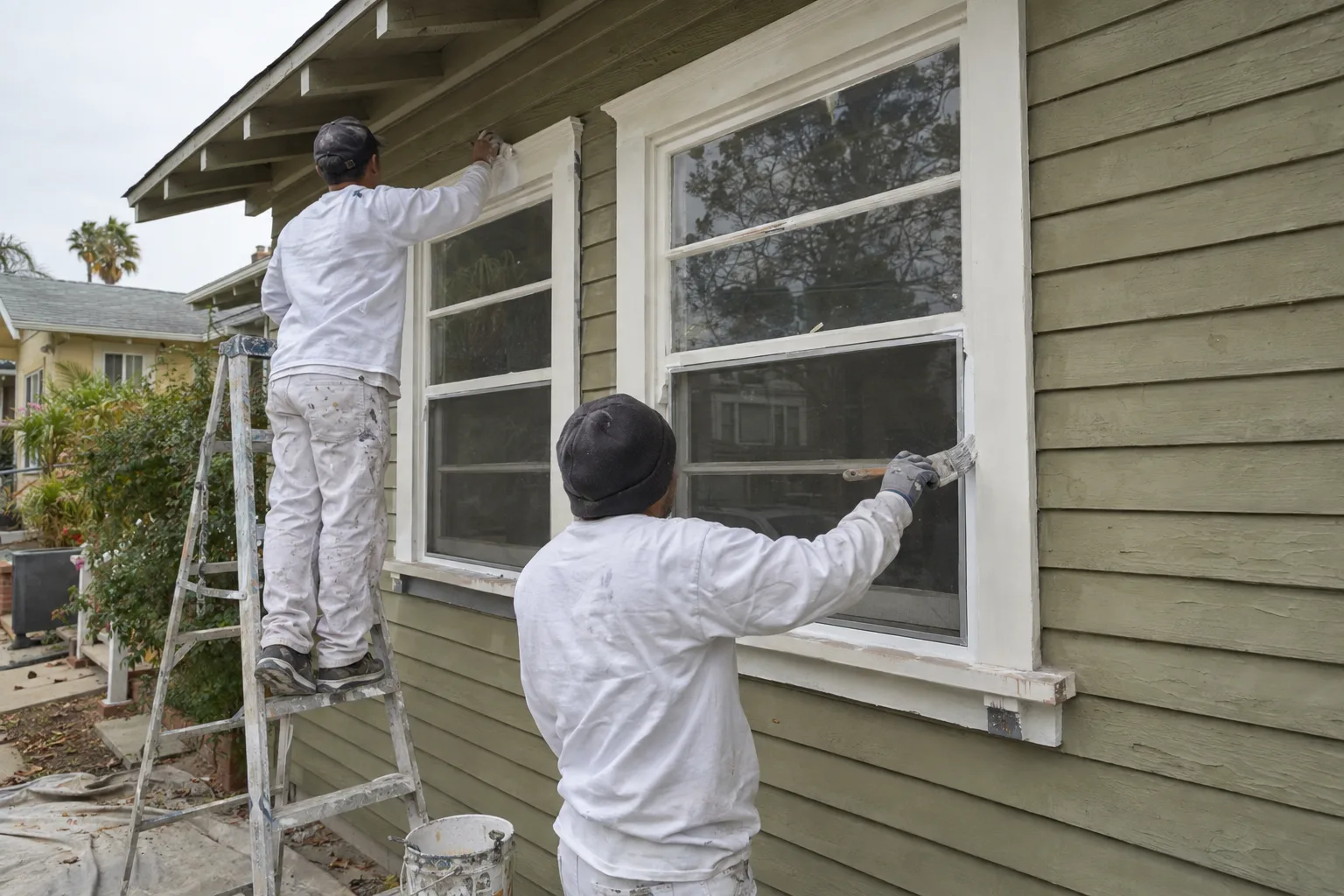
Prep and primer included on every exterior - wood, stucco, or mixed material.
What Goes Into Siding and Trim Painting in Los Angeles
Siding and trim painting is a material-specific process - not a single coat over whatever's there.
A proper siding and trim painting job starts before any paint touches the wall. Surface preparation - sanding, cleaning, and patching before primer goes on - determines how long the finish lasts. Exterior primer is the bonding layer that locks new paint to weathered or bare material. Skip it, and the finish coat fails early.
Remodeling & More LA includes surface preparation and priming in every exterior project. Wood siding, stucco exterior, fiber cement - each one gets treated based on what it is.
How LA's Climate Shapes the Way We Approach Every Exterior
Los Angeles sun breaks down exterior paint faster than most homeowners expect.
UV paint degradation - the climate-driven process that accelerates paint breakdown in Southern California - hits harder here than in coastal cities further north. Southern California averages well over 280 sunny days per year. That sustained UV exposure chalks paint surfaces, fades pigment, and eventually lifts the bond between paint and substrate.
Here's what matters about LA's climate: coastal marine air and winter rain compound the UV damage. Once the surface coat starts to fail, moisture finds its way under the paint film. On wood siding, that moisture gets absorbed into the grain. On stucco exterior, it can work into hairline cracks.
Getting ahead of that cycle - before the material underneath absorbs moisture - is the whole point of this work.
A Call We Often Get: Paint Lifting at the Trim Before the Siding Shows Wear
Trim boards fail before siding because they face sun from multiple angles at once.
A situation we run into often: a homeowner calls because the paint on their window casings is bubbling or flaking, but the main body of the house still looks decent. They're not sure whether to paint everything or just address the trim.
This is one of the most common exterior painting decisions we help people think through in Los Angeles. Trim boards - especially those facing south or west - absorb direct sun for more hours per day than flat siding panels. They also sit at junctions where water can pool briefly after rain. That combination accelerates UV paint degradation on trim faster than on the surrounding wall surface.
What we typically find when we look closely: the trim has lost its primer bond. Sometimes the original coat was applied without proper surface preparation. Sometimes it was painted over with an incompatible product.
The right response isn't always a full-house repaint. But it's never just a quick topcoat over lifting paint, either. We assess the trim condition, the siding condition, and the substrate - wood, stucco, or mixed material - and we recommend the scope based on what we actually see. Sometimes that's trim-only. Sometimes the siding shows early signs of the same problem and it makes sense to address both together.
Either way, the prep process is the same: clean, sand to a sound surface, spot-prime any bare areas, full prime coat, then finish. Three coats minimum where the surface has been compromised. Not a rollover.
Why Material Type Determines How We Start, Not Just What We Use
Wood siding and stucco exterior require different preparation - treating them the same produces inconsistent results.
Wood siding - the primary substrate on Craftsman-style homes throughout Pasadena and Glendale - is porous and grain-directional. It needs to be sanded with the grain, spot-primed at any bare or weathered sections, and allowed to fully dry before primer goes on. Moisture content matters. Paint applied over damp wood lifts within a season.
Stucco exterior, which is the dominant surface type across the San Fernando Valley, behaves differently. It's not porous in the same way, but it holds hairline cracks that need to be filled before primer or paint. Applying primer directly over unpatched stucco traps the crack pattern in the finish and it telegraphs through.
Fiber cement and mixed-material exteriors - common on 1990s and 2000s construction across LA - need a specific bonding primer that adheres to non-porous surfaces. Standard latex primer doesn't bond to fiber cement the way it bonds to wood.
Matching the starting point to the material is not optional. It's why the same crew handles prep and finish on every project.
From Surface Assessment to Final Coat - Our Preparation-First Approach
Every exterior starts with a surface read before a brush or roller touches the wall.
Our standards for siding and trim painting:
- Material identification first.Wood, stucco, fiber cement, or composite - each gets its own prep sequence.
- Surface preparation is never skipped.Sanding, cleaning, and patching happen before any primer goes on.
- Exterior primer matched to the substrate.Bonding primer for non-porous surfaces; oil-based or shellac-based primer for bare or weathered wood.
- Trim boards cut in by hand.No masking errors at window casings, eave lines, or corner boards.
- Finish coats applied in sequence.Not rushed. LA's heat can flash paint too fast on direct-sun walls - we account for that.
- Final visual check at every elevation.Coverage consistency and edge work confirmed before we're done.
No steps handed off. The same crew that preps the surface applies the finish.
How We Paint Wood Siding and Stucco Trim Without Cutting the Prep
Our process runs in four stages - assessment, preparation, application, and final walk.
The Surface Assessment
We look at every elevation of the building. Surface condition, substrate type, existing paint adhesion, and any areas where moisture has already worked its way in. On wood siding, we press for soft spots. On stucco exterior, we check for cracks wider than hairline. This tells us the full scope before any work starts.
Surface Preparation
This is where most of the time goes - and it should be. Loose paint is removed. Surfaces are cleaned of dust, chalk, and any biological growth. Cracks in stucco are filled and allowed to cure. Wood is sanded to a sound, clean surface. Bare sections get spot-primed immediately to prevent moisture absorption while the project progresses.
Paint Application
Full primer coat goes on first. We match the exterior primer to the substrate - this is not a one-size product on every wall. Finish coats follow after the primer has fully cured. On LA's hot, sun-facing walls, we watch for flash drying and adjust timing accordingly. Trim boards are cut in by hand at every edge.
Final Walk
We walk every elevation with the homeowner. Coverage, edges, color consistency - confirmed before the project closes. Any touch points that need addressing get handled on-site, same day.
Siding and Trim Painting Across Los Angeles - Pasadena to the San Fernando Valley
We paint exteriors across a wide stretch of greater Los Angeles.
Remodeling & More LA dispatches from Studio City. That puts us close to Craftsman neighborhoods in Pasadena and Glendale, stucco-heavy streets through the San Fernando Valley, and flatland areas west toward Santa Monica, Culver City, and Inglewood. We also serve Burbank, West Hollywood, Beverly Hills, and Long Beach.
Full neighborhood list available - call or message to confirm your area.
Ready to See What Your Exterior Looks Like Under a Fresh Coat
Siding and trim painting in Los Angeles starts with a surface assessment, not a guess.
Call Remodeling & More LA at +1 (769) 379-9653 or email info@remodelingmore.com to schedule your exterior review. Tell us your surface material and what you're seeing - we'll take it from there.