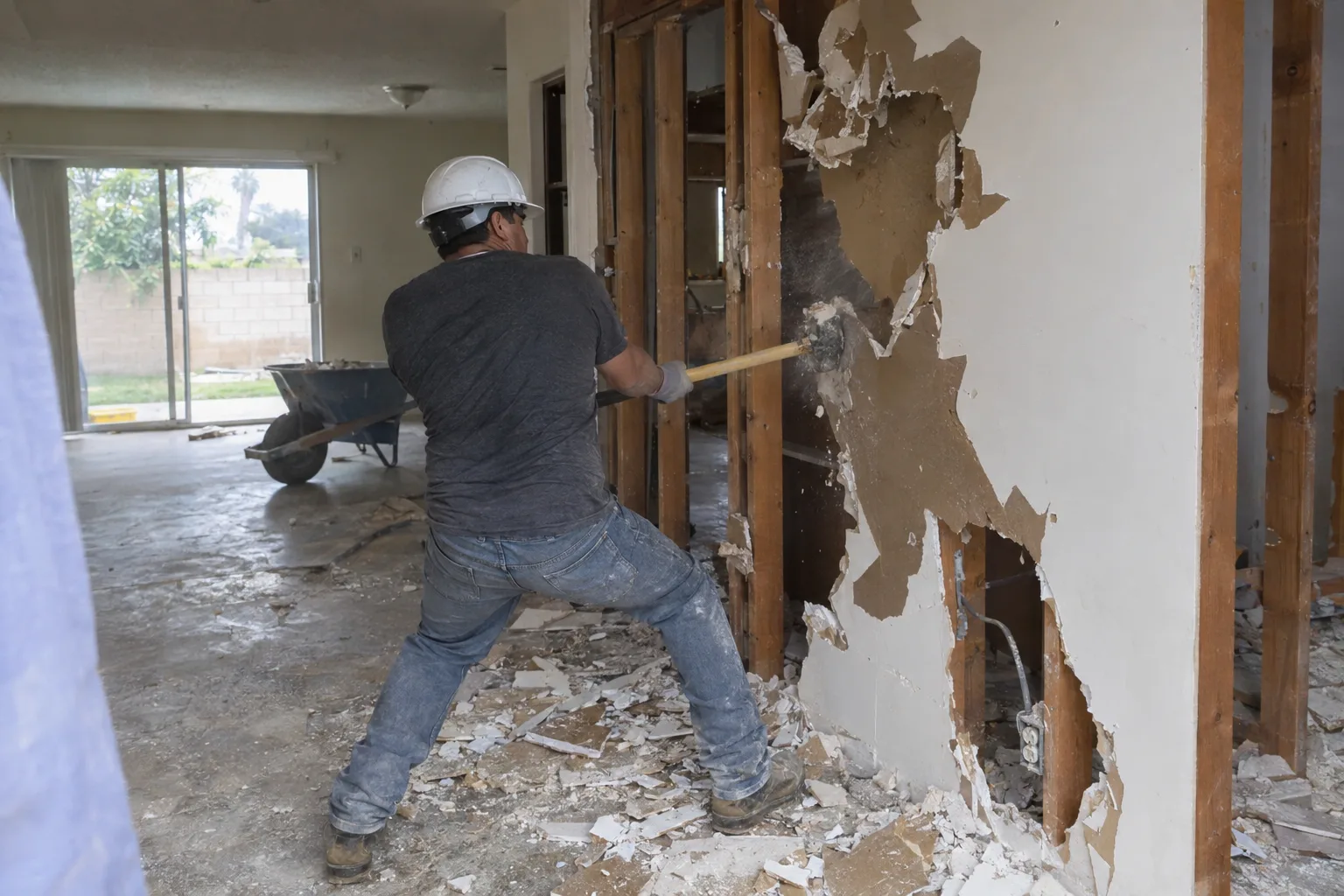
# Demolition Done by the Same Crew That Builds What Comes Next
One crew handles demo, site prep, and construction - no contractor handoffs, no schedule gaps in Los Angeles.
What Demolition Services Cover on a Los Angeles Project
Demolition is phase one. Everything else depends on it being done right.
The crew doing the demo needs to know exactly what the construction drawings require. They need to know which walls stay, which systems get preserved, and how the site needs to be left. When the demo crew and the build team are different companies, things get missed. Framing dimensions get ignored. Utility lines get left in the wrong place. The build team arrives at a site that isn't ready for them.
At Remodeling & More LA, interior demolition, structural demolition, and selective demolition - targeted removal that preserves surrounding finishes or systems - are all performed in-house. The same people who clear the site are the same people who frame, build, and finish it.
How LA Properties Shape the Way We Approach Demo Work
Los Angeles construction stock creates conditions that require site-specific knowledge before the first tool comes out.
Here's what most homeowners don't realize about demo work in LA: older properties - many built before 1980 - often carry surprises behind the drywall. Galvanized plumbing. Knob-and-tube wiring runs through framing bays. Original stucco layered over wood lath. None of that shows up on a basic floor plan.
The San Fernando Valley has large volumes of mid-century ranch homes where additions were built without proper permits. When you start demo on a wall, you may find two eras of framing stacked against each other.
We run crews through the I-405, I-5, and SR-134 corridors daily - reaching Van Nuys, Burbank, Long Beach, and Anaheim. That consistent field exposure across LA's diverse building stock means we know what to look for before the first swing happens.
A Scenario We Handle Regularly Before a Full Renovation Begins
Complete home renovations in Los Angeles almost always start with a demo phase that's more complex than it looks on paper.
A call we often get goes like this: a homeowner in Burbank or Van Nuys has approved plans for a full kitchen and living room renovation. The drawings show three walls coming down. The property is a 1960s ranch-style home with an added breakfast room from the '80s.
What the drawings don't show is whether that breakfast room addition has its own independent framing or whether it shares a wall cavity with the kitchen load path. You don't know until you open it up.
In a situation like this, our team reads the structural drawings before day one. We map the load-bearing elements - the structural components that carry roof or floor weight and must be sequenced carefully during removal. We flag any walls that need temporary shoring before demo begins. We clear the non-structural elements first, working toward the structural items in the right order.
Debris removal - hauling demolished materials off-site - happens as we go, not all at once at the end. That keeps the site accessible and prevents material from stacking up in front of systems that need to stay live.
By the time demo is complete, site preparation - the cleared, ready-to-build condition that follows - is already in progress. Framing can begin the next scheduled day. There is no idle window between phases. That's not a feature. That's just how the work gets done when one crew owns the whole sequence.
Every Phase Hands Off Clean - From Demo Through Final Build
Your project doesn't stall between demolition and construction when one crew controls both.
A question property owners often ask before scheduling demo: "How do I make sure the site is in the right condition when construction starts?" The answer is straightforward when the same team does both.
Our demolition crew leaves the site in framing-ready condition. That means debris is cleared, utility runs are documented, and any structural openings are shored correctly. The framing phase - the construction stage that follows completed demolition - starts from a clean baseline.
No separate inspection window between contractors. No back-and-forth about what was left where. The build timeline moves forward because the demo crew already understood what the build requires.
How We Sequence Demolition So the Build Phase Starts Right
Controlled sequencing is the difference between a clean demo and a rebuild problem.
Our demolition standards aren't about speed. They're about accuracy. Every project follows the same logic:
- Drawings reviewed before tools arrive.We read structural plans, not just scope-of-work summaries.
- Load-bearing elements identified first.Structural demolition requires planned sequencing - we mark what stays before anything comes down.
- Selective demolition where required.Targeted removal that protects adjacent finishes, systems, or framing bays that are staying.
- Debris removed continuously.Not stockpiled. Materials leave the site as demo progresses.
- ADU pre-construction clearance handled correctly.For garage conversions or backyard ADU builds, demo scope follows ADU-specific site prep requirements - different from standard remodel demo.
- Site left framing-ready.Not just clear - ready for the next phase to begin.
From First Swing to Site-Ready - Our On-Site Demolition Steps
Every demo job follows a fixed sequence so the build phase starts from solid ground.
Site Walkthrough and Assessment
Before any demolition begins, we walk the site with the construction drawings in hand. We locate load-bearing walls, active utility lines, and any conditions the drawings don't reflect. On older LA properties, this walkthrough frequently surfaces framing anomalies from previous unpermitted additions. We note everything before demo starts.
Demolition and Debris Removal
Interior demolition - selective removal of walls, flooring, ceilings, or fixtures - begins with non-structural elements. Structural demolition follows, sequenced to protect what stays. Shoring is placed before structural walls open. Utility stubs are capped or flagged per plan requirements. Crews work in phases, not all at once, so the site stays controlled throughout.
Post-Demo Site Prep
Once demolition is complete, site preparation begins. The cleared space is checked against the framing plan. Any remaining material on-site is removed. Utility access points are confirmed. The space is handed directly to our framing crew - the same team - without a scheduling gap. From this point, the framing phase begins on schedule.
For ADU pre-construction work - demolition that clears the way for a garage conversion or new accessory dwelling unit build - site prep follows LA-specific ADU foundation and utility placement requirements before framing begins.
Demolition Services Across Greater Los Angeles and Surrounding Communities
We run demo crews across LA from our Studio City location every week.
Remodeling & More LA serves Los Angeles, West Hollywood, Beverly Hills, Culver City, Burbank, Glendale, Van Nuys, Santa Monica, Pasadena, Long Beach, Torrance, Inglewood, Hawthorne, Anaheim, and communities throughout the San Fernando Valley. Full service area listed on our contact page.
Schedule Your Demo Walkthrough Before Work Begins
Demo starts with a site walkthrough - not a guess about what's behind the wall.
Call Remodeling & More LA at +1 (769) 379-9653 or email info@remodelingmore.com to schedule your walkthrough. Tell us what you're building after demo is done. We'll scope the demolition around the construction phase that follows - so day one of the build isn't delayed by day one of demo.