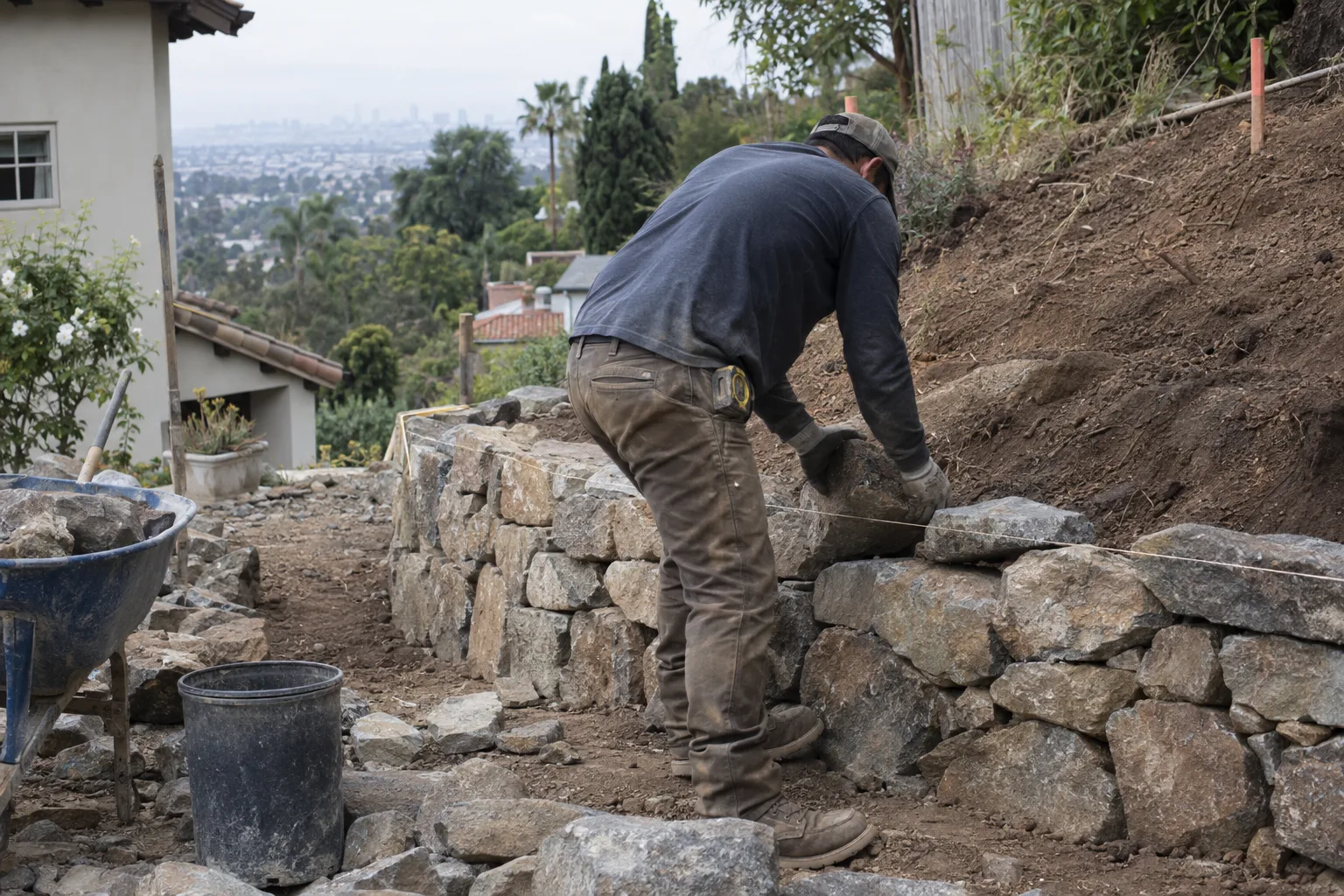
One crew for your retaining wall, patio, and exterior stone - no handoffs between trades.
What Stone and Masonry Can Do on a Los Angeles Property
Natural stone - a material category that includes granite, limestone, travertine, and fieldstone - brings density and permanence to outdoor surfaces. Masonry, the trade of constructing with stone, brick, or concrete block using mortar and traditional setting methods, is a hands-on craft. You can see the difference between masonry done carefully and masonry done fast.
At Remodeling & More LA, stonework covers retaining walls, hardscape features, patios, walkways, and exterior surfaces. One crew handles all of it. Explore hardscape design and installation or retaining wall construction to see how stone fits into a broader outdoor build.
How Stone Fits the Architecture of LA's Older Neighborhoods
Older Los Angeles properties were built with stone and masonry as part of their structure - not as an afterthought.
Pasadena has a high concentration of Craftsman and Mission Revival homes, many built between 1905 and 1940. Stone foundations, low garden walls, and fieldstone steps are original to those properties. When you add a new wall or patio today, the finish has to match what's already there.
Beverly Hills and Malibu present the same challenge at a larger scale. Estates with original limestone or granite features need additions that hold the same proportions and color range. Getting that right means understanding how older stones were laid - mortar joint width, coursing pattern, and the texture of the face.
Coursed stonework - a laying pattern using uniform horizontal rows - is common in formal Pasadena-era architecture. Dry-stack stone - a technique using no mortar between stones - appears in garden walls and hillside retaining structures across Malibu and the canyons. Both require different handling. Both are in our range.
A Common Call We Get About Mismatched Masonry
The most common masonry question we get in Los Angeles is about how to match new work to existing stone.
A situation we encounter regularly: a homeowner in a hillside neighborhood wants to extend a retaining wall - a structural element that holds back soil on sloped lots - along the back of the property. The original wall was built with rough-cut fieldstone, dry-stacked with wide natural gaps. A previous approach used a concrete extension faced with thin stone veneer to approximate the match. The color is similar. But the proportions are off. The veneer stones are cut too clean. The joints are too tight. From ten feet away, you can see exactly where the old wall ends and the new section starts.
What that situation actually calls for is sourcing fieldstone that matches the existing color range and size. It means laying it dry-stack with the same gap width as the original. And it means understanding that the irregular face of older stonework isn't a flaw - it's the point.
We see this same dynamic on patios in Pasadena, on garden steps in Beverly Hills, and on exterior chimney surrounds throughout the San Fernando Valley. The solution isn't always complex. But it does require knowing what the original work was doing and why.
This is where working with an in-house crew matters. When the same team that built your retaining wall also handles the patio and the steps, the eye for consistency carries through. Stone is a visual trade. Continuity across surfaces only happens when one crew sees the whole picture.
Why Material Knowledge Matters More Than Product Selection
Choosing the right stone matters less than knowing how to set it properly.
Homeowners often focus on selecting a stone type. That decision matters. But it's secondary to setting method, mortar joint - the visible line between stones that affects both structural bond and visual character - width, and how the face of each stone is oriented.
Limestone sets differently than granite. Travertine has a more porous face and needs different prep before mortar contact. Fieldstone, by its nature, is irregular - every piece requires individual placement judgment.
Before any stone goes down, we review the structural role of the surface: load-bearing, retaining, or finish. That tells us the setting method. Then we look at the existing surfaces on the property. That tells us the joint width, the coursing approach, and the face texture to match. Material selection happens after those decisions are made - not before.
That sequence keeps new stonework looking like it belongs on the property.
How We Approach Every Stonework and Masonry Project
Every masonry job at Remodeling & More LA follows consistent quality standards across materials and surfaces.
- Stone sourcing:We identify materials that match existing property stonework in color, texture, and scale before ordering.
- Surface prep:Every base surface is checked for drainage slope, compaction, and stability before stone is set.
- Setting method:Dry-stack or mortar-set is determined by the structural role - not by default.
- Mortar joint control:Joint width and profile are kept consistent across the entire surface.
- Coursed vs. irregular patterns:Laying pattern is matched to existing architecture on the property.
- Drainage integration:Retaining walls include drainage planning to manage hydrostatic pressure from hillside soil.
- Cleanup:Site is cleared of cut stone debris and mortar waste at the end of each work day.
From Site Conditions to Finished Surface - Our Build Sequence
Every stonework project follows a clear sequence from first look to final course.
Site Assessment
We start by walking the site. We look at soil type, slope, drainage, and the existing stone or hardscape on the property. For retaining walls on hillside lots - common across Malibu, Silver Lake, and the canyons - we assess how much lateral pressure the wall will face. That determines wall thickness and, where needed, footing depth. We also note the existing mortar joint profile and stone face texture so new work can match it.
Stone Setting
Stone is set course by course. For mortar work, joints are tooled to a consistent profile before the mortar sets - not after. For dry-stack, each stone is fitted individually for face alignment and gap width. Every wall, patio, or walkway surface we build uses full-thickness natural stone or masonry block.
Final Walkthrough
Once the surface is complete, we walk it with the homeowner. We point out joint lines, drainage slope on flat surfaces, and how new sections align with existing stonework. Any mortar haze on stone faces is cleaned before we leave. The goal is a finished surface that holds structurally and reads visually as part of the property - not as an addition.
Stone and Masonry Services Across Greater Los Angeles
Remodeling & More LA handles stonework and masonry throughout the greater Los Angeles area.
We're active in Pasadena, Beverly Hills, Malibu, and across the San Fernando Valley - neighborhoods with a high concentration of older properties where stone is already part of the architecture. We also work throughout the Westside, the South Bay, Burbank, Glendale, Santa Monica, and Long Beach. If you're in greater Los Angeles, we're in range.
Ready to Add Stone to Your Property?
Natural stone and masonry built to fit your property - one crew, no trade handoffs.
Contact Remodeling & More LA to talk through your project. Call us at [+1 (769) 379-9653](tel:+17693799653), email [info@remodelingmore.com](mailto:info@remodelingmore.com), or fill out the form on this page. We'll review your site conditions and get back to you with a clear plan.